
Prism. Parallelepiped
author: Петя
viewed: 4474 times
Българска версия: 
- Definition: Polyhedral - with two equal n-walls and with n equal surrounded parallelograms , is called prism.
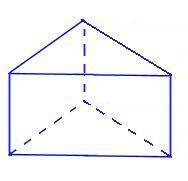
The prism is:
1.right, if its surrounded edges are perpendicular on the radix;
2.regular, if the prism is right and its radix is regular poluhedral;
3.tilted, if its surrounded edges are not perpendicular on the plane of the radix.
Diagonal on a prism is called the segment which connects two prism's vertix which are not from the same wall.
Height on a prism is called each line (which endings are from the planes on radixes) is perpendicular on these planes.
Lenght on each height is equal on the distance between radixes' planes.
- Definition: If prism has radixes which are parallelograms, then this prism is called parallelepiped.

One parallelepiped is called right-angled when all its walls are rectangles.
Cube - right-angled parallelepiped with walls which are squares.
Parallelepiped's characteristics:
- Opposite walls are parallel and equal parallelograms.
- Parallelepiped has two diagonal intersections and 4 diagonals.
- Parallelepiped's diagonals intersect themselves in one point which devisits these diagonals in two equal segments.
Right-angled parallelepiped's characteristics
- DIagonal intersections are equal rectangles;
- Its diagonals are equal;
- If its dementions are a, b, c, and its diagonal is d, then d2 = a2 +b2 +c2.
Area and volume on prism
- surrounded area S is equal on the sum of surrounded walls' areas. Full area S1 is equal on the sum of surrounded walls' areas and plus radixes' areas.