
Trihedral angle
author: Петя
viewed: 11184 times
Българска версия: 
- Definition: A set of the point О, the rays a, b, c and all iternal points for the angles x, y, z, is called trihedral angle (trihedron).
- The point О is called vertex,
- rays ОА, ОВ, ОС – edges, (when А, В and С lie on а, c, b)
- angles х, y, z – edge angles,
- internal areas of x, y, z – walls,
- dihedral angles х1 = (ОАВ, ОАС), у1= (ОВС, ОВА), z1 = (ОСА, ОСВ) – dihedral angles of the trihedral angle.
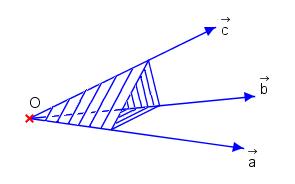
We mark the trihedral angle like this: ОАВС.
Let's assume that the points А, В,С, are chosen so that ОА = ОВ = ОС = 1.
Note: Analogically are defined the notions hexahedron etc.
- Theorem 1: The sum of the three edge angles of a trihedral angle is 360°. x+y+z<360°.
- Theorem 2: The sum of every two edge angles of a trihedral angle is always bigger that the third one
x+y>z, y+z>x, z+x>y.
For every base edge of a regular n – angled pyramid there are two base edges that form trihedral angle with a neighbourhood edge.
- Theorem: The theorem of the three cosines. If one shoulder of a sharp angle is parallel or lies in one plane, and the other form angle x with the plane, then the cosine of the angle equals the cosine of the projection of the angle on the plane multiplied by cos x.
Consequence of the theorem of the three cosines: If one of the shoulders of a sharp angle у is parallel or lies in a plane and the other one intercepts the plane, then for the projection у1 of an angle у onto the plane the following is true у1<у.