
An equation on a line
author: Петя
viewed: 1919 times
Българска версия: 
A common equation on a line
One line in the plane can be define by different ways:
- by two given points tgrough which it passes;
- by a given point through which it passes and a given vector that is perpendicular to the line;
- by a given point through which it passes and a given vector that is collinear with the line;
- by a given point through which it passes and a given angle between the line and a given axis.
Let one line g is define by some way and М is an arbitrary point.
- If (х; у) is a point of the line, its coordinations satisfy Ах + Ву + С = 0 (1);
- If the coordinations (х; у) on one point М satisfy (1) then М lie on g.
The equation (1)is called common equation on the line g.It can be written g: Ах + Ву + С =
0 or g =coincide Ах + Ву + С = 0
Contrariwise,every equation from first exponent in relation to х or у: Ах + Ву + С = 0 as at least one of А and В isn't zero is the common equation on exactly one line.
Location on the line in relation to the coordinate axises according to the coefficients on its common equation
Let is given a line g with a common equation g: Ax+ By +C = 0. The vector n→(A; B) is perpendicular to g.Then the vector u→(-B; A) is parallel on g because u→.n→ = 0. If any of the numbers А and В isn't zero the vector u→ and consequently the line g are parallel on one of coordinate axises.The next cases are possible:
- С = 0. Now the equation g is Ax + By = 0 and it is satisfied from the coordinations (0; 0) on the beginning О. The line pass through the beginning on the coordinate system.
- А = 0. Now the equation on the line is Ву + С = 0, i.е у = -С/В.The vector u →(-B; 0) is parallel on the axis Ох. Consequently the line is parallel on the axis Ох,too.Every points on the line have one and the same ordinate. If and С = 0 then we get the equation on the axis Ох: у = 0.
- В = 0. Now the equation on the line is Ах + С = 0, i.е х = -С/А.The line is parallel on the axis Оу. If and С = 0 then we get the equation on the axis Оу: х = 0.
- If А, В and С are different from zero.The line crosses and the both coordinate axises and don't passes through the beginning on О.
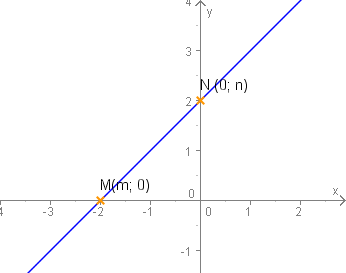
If its truncated points with the coordinate axises are М (m; 0)and N(0; n) the numbers m and n are called segments on the line from the coordinate axises.
If we replace consecutively the coordinations on М and N in the equation on the line we get A.m+ B.0 + C= 0 → m = -C/A, A.0 + B.n+ C = 0 → n = -C/B.
The equation on the line can be transform as follows and it is: x/m + y/n = 1 (2).
The equation on one line written in the form (2) is called a segmently equation on the line.
Редактирано от: jodika