
Curves from second exponent
author: Петя
viewed: 2861 times
Българска версия: 
Circle
- Definition: Circle is the set of the points in a plane which are located on a given distance from a given point.
The distance is called radius and the point – center of the circle.
We have a rectangular coordinate system Оху in the plane. We will find an equation of the circle k with center С (а; b) and radius R.
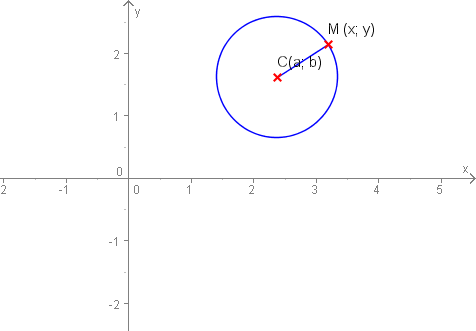
One point М (х; у) lies on the circle k if and only if when CM = R, i.е. when sqrt ((x – a)2 + (y – b)2) = R2. Resulted equation can be written in that way (1) (x– a)2 + (y – b)2 = R2. It is called equation of the circle k.
One point lies on the circle if and only if its coordinations satisfy the equation of the circle.
If the beginning on the coordinate system coincide with the center of the circle, i.е. if а = b = 0, the equation on the circle is x2 + y2 = R2.
This equation is called central equation of a circle.
The advanced form the equation (1) of circle is (2) x2 + y2 – 2ax – 2by + a2 + b2 – R2 = 0. Because the left part of the equation (2) is multinomial from second exponent in relation to х and у, we say that the circle is curve from second exponent.
The common appearance of the equation on curve from second exponent with two variables is (3) Аx2 + Bxy + Cy2 + Dx + Ey + F = 0 where at least one of the coefficients А, В and С isn't equal to zero.
When we compare the equations (2) and (3), we can see that it is necessary condition the equation (3) to be an equation of a circle is (4) А = С and different from zero, В =0. This condition however isn't enough. For example, the equation:
(x – 2)2+ (y – 3)2= -9, i.е. x2 + y2 – 4x – 6y + 22 = 0 isn't satisfied from the coordinations of any point. We say that it is an equation on imaginary circle.
(x – 3)2 + (y + 1)2= 0, i.е. x2 + y2– 6x + 2y + 10 = 0 is satisfied only from the coordinations of the point
М (3; -1).We say that it is na equation on a point or on a circle with radius 0.
When the coefficient in the equation (3) doesn't implement the condition (4), the set of points which coordinations satisfy the equation is another kind of line. For example, we know that an equation from second exponent of the kind:
y= ax2+ bx + c, where а isn't equal to 0 is an equation on a parabola;
xy– a = 0, i.е. у= а/х, where а isn't equal to 0 is an equation on a hyperbola.
Consequently the parabola and the hyperbola are also curves from the second exponent.
Ellipse
- Definition: An ellipse is called set of the points in the plane the sum of the intervals that by two given points is constant number, longer than the distance between the two points.
We have the points F1 and F2.
These points are called focuses of the ellipse.
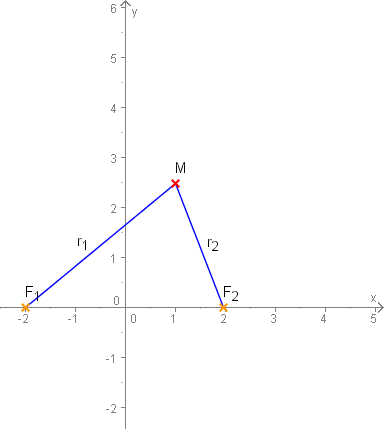
The segments F1M and F2M which join the focuses with an arbitrarily point М of the ellipse are called focal radiuses. The lenghts of these segments we mark with с r1 and r2.
Let the length of the segment F1F2 is 2с and the sum of the lengths on the focal radiuses of an arbitrarily point М of the ellipse is 2а where а>с.
Initiate coordinate system Оху with a beginning middle О on the segment F1F2, abscissa -F1F2 oriented from F1 to F2. Then the coordinations on the focuses F1, F2 and on a point М are F1 (-с; 0), F2 (с; 0) and М (х; у).
According to the definition the point М lie on the ellipse if and only if when r1 + r2 = 2a, sqrt ((x + c)2 + y2) + sqrt ((x – c)2 + y2) = 2a.
We transform the equation of the ellipse as follows and we get x2/a2+ y2/(a2 – c2) = 1.
The condition is that а>с. Then the difference а2– с2 is a positive number. We can lay а2 – с2 = b2 and accept that b>0.
With this symbol the equation of the ellipse (5) x2/a2 + y2/b2 = 1. It is called a canonical equation on the ellipse.
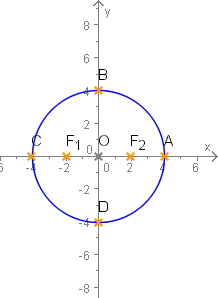
On the plan is given the location of the ellipse is presented with its canonical equation (5) in relation to the coordinate axises Ох и Оу.
Abscissas on the truncated points А and С on the ellipse with the axis Ох can find when in the equation(5) put у = 0. We get А (а; 0), С(-а; 0). Likewise we find В (0; b), D (0; -b).
The point О is called center and the points А, В, С,D – nodes on the ellipse.
The segment АС = 2а is called large axis and the segment BD = 2b – small axis on the ellipse.
The lines АС and BD are called axises on the ellipse. Every of the two axises on the ellipse is its axis on symmetry.
The number е = с/а is called eccentriction of the ellipse. Because 0<с<а then 0<е<1, i.е. the eccentriction of the ellipse is a positive number smaller than 1. The more it is closer to 1 the more longer is the ellipse and the more it is closer to 0 the more the ellipse looks like an circle.
When е = 0 we get с = 0, b = а and the equation (5) е x2 + y2 = a2, i.е. the elipse „degenerate” in an circle.
The equation(5) on the ellipse is an equation from second exponent in relation to х and у, i.е. the ellipse is a curve from second exponent.It is called canonical because of the special location on the ellipse in relation to the coordinate axis,it has a simplified appearance. Canonical equation on the ellipse is also equation of the kind (5) when b>а.Then the focuses on the ellipse are on the axis Оу.
Hyperbola
- Definition:Hyperbola is called a set of the points in tha plane the difference of the intervals that by two given points is a constant number smaller than the distance between the two points.
Let are given the points F1 and F2.These points are called focuses on the hyperbola.The segments F1M and F2M that join the focuses with an arbitrary point М from the hyperbola are called focal radiuses. The lenghts on these segments we mark with r1 and r2.
Let the lenght on the segment F1F2 is 2с and the difference of the lenghts on the focal radiuses of an arbitrary point М of the ellipse is 2а where а<с.
We lead in a coordinate system Оху with beginning the middle О on the segment F1F2, the abscissa - F1F2, directed from F1 to F2. Then the coordinations on the focuses F1, F2 and on the point М are F1 (-с; 0), F2 (с; 0) and М (х; у).
The definition is that the point М lie on the ellipse if and only if when |r1 - r2| = 2a, |sqrt ((x + c)2 + y2) - sqrt ((x – c)2 + y2)| = 2a.After transformations this equation take on the appearance (6)x2/a2 - y2/b2 = 1 where с2 – а2 = b2.
The equation(6) is called a canonical equation on the hyperbola.
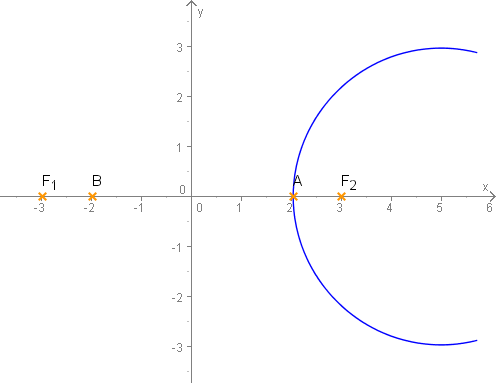
On the plan is given the distance on the hyperbola presented with its canonical equation (6) in relation to the coordinate axis Ох и Оу.
The abscissas on the crossed points А and В on the hyperbola with the axis Ох we find when in the equation(6) put у = 0. We get А (а; 0), В(-а; 0).
The axis Ох and Оу are called axis on the hyperbola;
- the axis Ох – real axis on the hyperbola;
- the axis Оу – imaginary axis on the hyperbola.
Every of the two axis on the hyperbola is its axis on symmetry.
The number е = с/а is called eccentriction on the hyperbola.As а<с then е>1.